The Space Between
When What Hurts Is Not What Happened - But What It Seemed to Mean
In relationships, what hurts us is not always only what happened. Often, it is the meaning we attach to what happened. This is one reason so many couples seek CBT couples counseling: not because the relationship is necessarily broken, but because assumptions, fears, and automatic thoughts can quietly shape how partners interpret each other.
Your partner comes home quiet, and your mind says, "They are angry with me." They forget to text back, and your mind says, "I am not important." They seem distracted during a conversation, and your mind says, "They do not really care."
These interpretations happen quickly. Most of the time, they are automatic. We do not sit down and choose them. They appear almost instantly - and often they once served a real purpose.
Why Automatic Thoughts Show Up So Quickly
Automatic thoughts in relationships do not come from nowhere. They are often shaped by old wounds, past relationships, family dynamics, insecurity, stress, or fear.
In many cases, these patterns originally developed as a form of protection. As children, they may have helped us make sense of situations that felt unpredictable, painful, or out of control. They may have helped us feel more prepared, more guarded, or more emotionally safe.
That is part of why they can be so difficult to change. Our brains learned to trust these thoughts. They became familiar. They became efficient. Even when we are now in a loving relationship, the same mental habits may still show up automatically - even when they are no longer protecting us. In fact, they may now be contributing to misunderstanding, conflict, and self-sabotage.
And once we believe the story, we react to it.
How Old Protective Patterns Can Create Self-Sabotage
This is one of the central ideas in CBT couples counseling: our thoughts influence our emotions and behaviours. In a relationship, that means what we assume about our partner can deeply affect how we speak, how we listen, and how close or distant we feel.
For example, if one partner thinks, "They never think about me," they may become cold, critical, or withdrawn. If the other partner thinks, "Nothing I do is ever enough," they may become defensive, shut down, or stop trying.
Neither person is responding only to the present moment. They are also responding to the meaning they have assigned to that moment.
This does not mean people imagine problems that are not real. Some relationships do include genuine hurt, neglect, or repeated disappointment. But even in healthy relationships, couples can suffer when distorted thinking patterns go unnoticed and unchallenged. If you have noticed that the same argument keeps coming back, automatic thoughts may be part of what keeps the cycle going.
Common Thinking Patterns That Affect Couples
Many relationship assumptions follow familiar patterns. These are known as cognitive distortions - deeply human mental shortcuts, especially common when someone feels vulnerable, anxious, or emotionally activated.
Common examples include:
- Mind reading - assuming you know what your partner is thinking
- Catastrophising - jumping to the worst possible conclusion
- Black-and-white thinking - seeing the relationship as all good or all bad
- Personalising - interpreting everything through the lens of personal rejection
- Over-generalising - turning one moment into "you always" or "you never"
These patterns are not signs of failure. But if they are left unchecked, they can quietly erode trust, increase defensiveness, and create distance between partners.
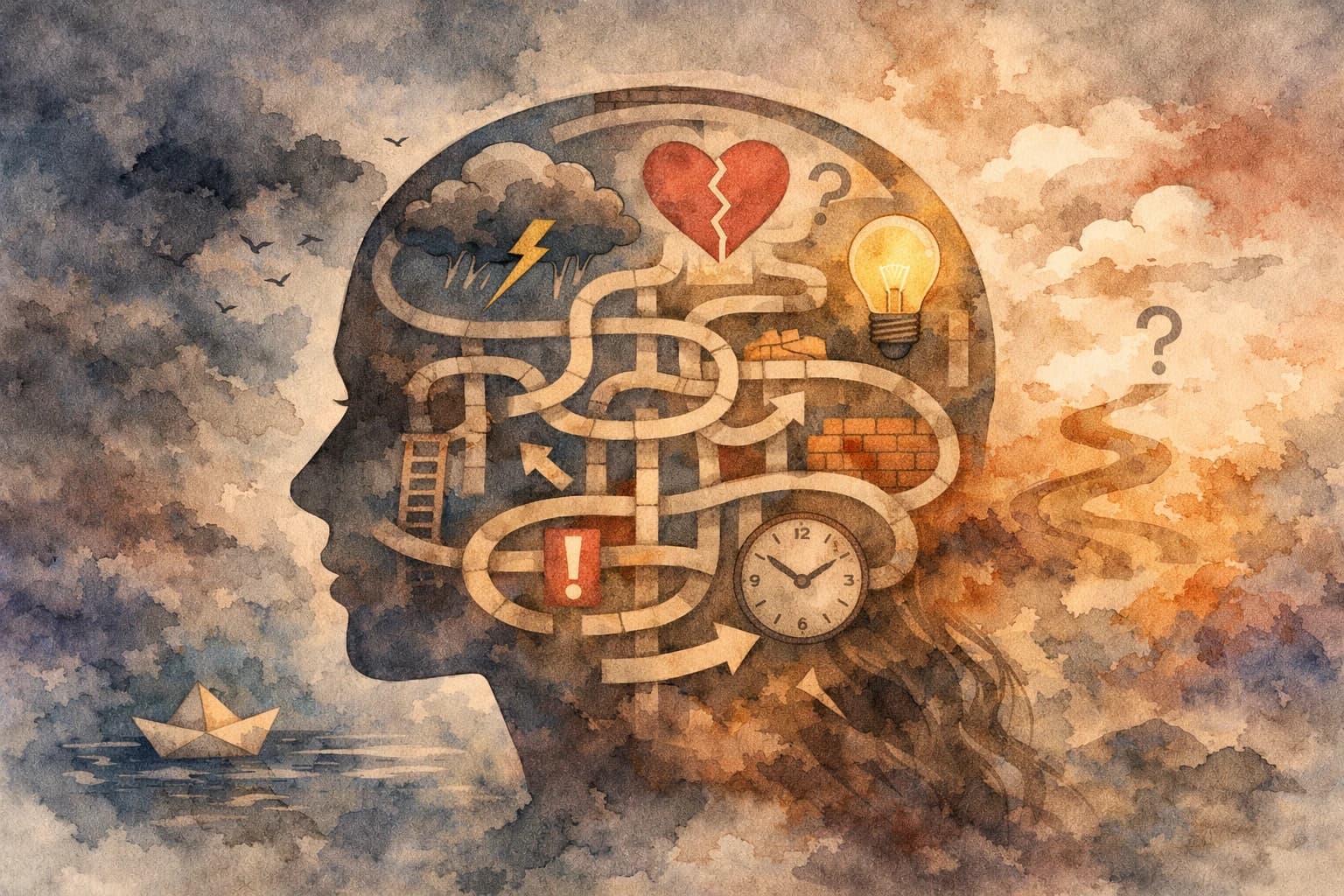
How CBT Couples Counseling Helps Separate Facts From Assumptions
In couples counseling, couples learn to notice these thoughts and become curious about them rather than automatically obeying them.
Questions might include:
- Is that interpretation definitely true?
- What else might be going on here?
- What did you feel in that moment?
- What old fear got activated?
- What did you need, and were you able to express it clearly?
This kind of work can be powerful because it helps people separate facts from assumptions.
There is a big difference between "My partner did not answer my message for three hours" and "My partner does not care about me." There is a big difference between "My partner needed time alone after work" and "My partner is emotionally leaving me."
When couples start to recognize those differences, they often feel less trapped by reactivity. Conversations become less loaded. Defensiveness softens. People begin asking instead of assuming.
That creates more room for honesty, clarity, and repair. Learning to talk openly about vulnerable topics - whether about intimacy, needs, or hurt - becomes much easier once the automatic stories are noticed and questioned.
Why Changing the Story Can Change the Relationship
At its heart, CBT couples counseling is not about forcing positive thinking. It is not about pretending everything is fine or talking people out of real feelings. It is about helping both partners think more clearly, respond more consciously, and understand each other more accurately.
Because in many relationships, the pain is not only in what is happening. It is also in the story growing around it.
When that story is examined with honesty and care, something important becomes possible: more truth, more compassion, and more space between the trigger and the reaction.
And sometimes, that space is exactly where reconnection begins.
Frequently Asked Questions
Automatic thoughts are the quick interpretations we make about our partners behaviour, often without realizing it. They are shaped by past experiences, insecurity, stress, or old emotional wounds and can strongly affect how we react in the moment.
When we assume we know what our partner is thinking, we often react to the story in our mind rather than the reality in front of us. Over time, this creates misunderstanding, defensiveness, and emotional distance.
Some of the most common patterns include mind reading, catastrophising, black-and-white thinking, personalising, and overgeneralising. These are normal mental shortcuts, but they can erode trust and connection if left unchallenged.
CBT couples counseling helps partners slow down, notice their automatic thoughts, and separate facts from assumptions. Couples learn to question the story they are telling themselves and communicate with more clarity and emotional awareness.