The Space Between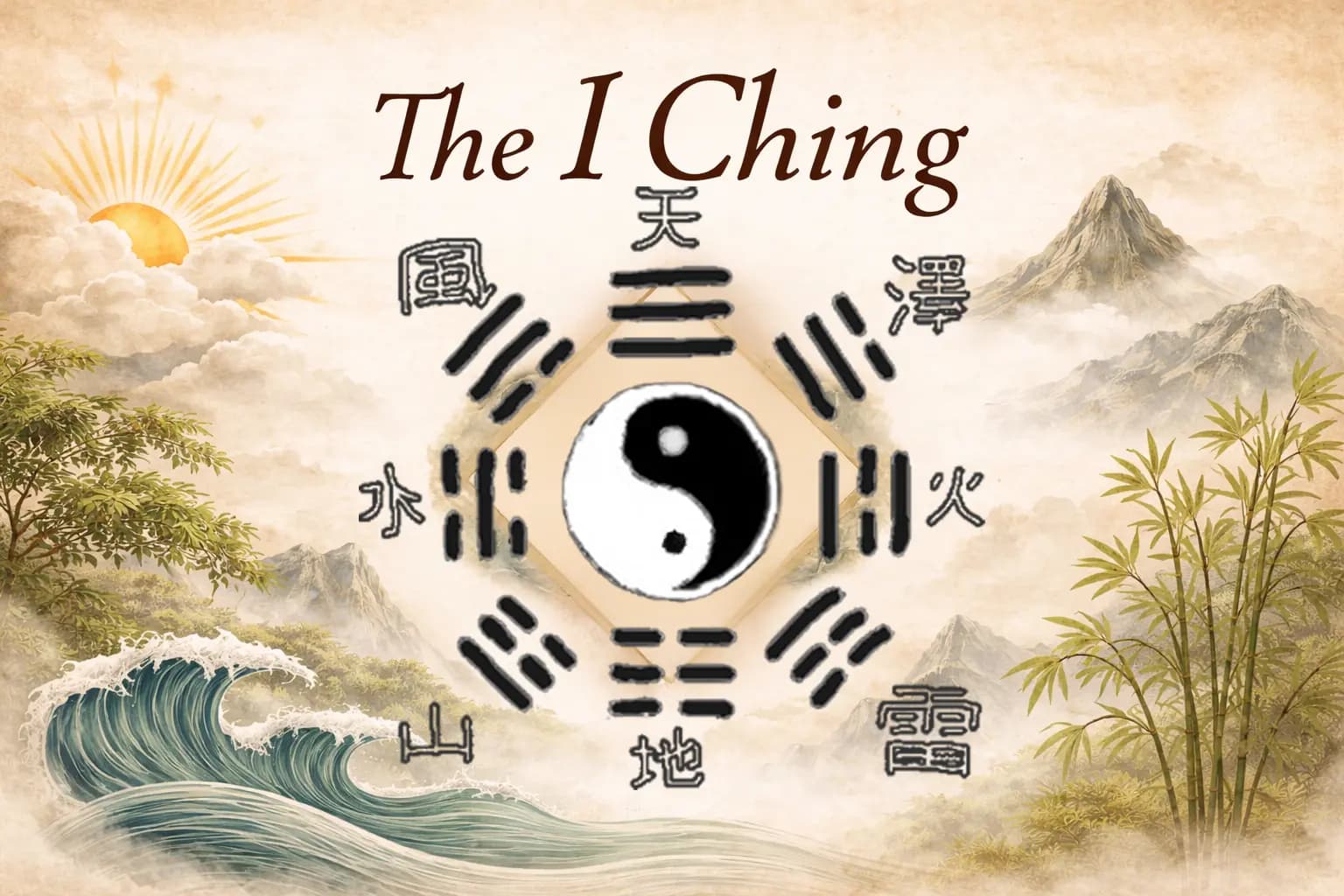
Where the Whole System Begins
If you are new to the I Ching, the first thing to understand is that the whole system begins with extraordinary simplicity.
Before there are 64 hexagrams, before there are changing lines, and before there are detailed interpretations, there are only two basic kinds of lines. One is solid. One is broken. That is the beginning of the Book of Changes.
These two lines are associated with yin and yang. The solid line expresses firmness, continuity, structure, action, and presence. The broken line expresses openness, receptivity, yielding, space, and response. Ancient source material on the Yi presents the system as rooted in yin and yang, the two fundamental complementary principles.
You could say this is where the I Ching begins to speak in its first symbolic language:
- Something and no-thing
- Form and space
- Definition and openness
- Black and white
Each one only makes full sense in relation to the other.
How the Whole System Grows From Two Lines
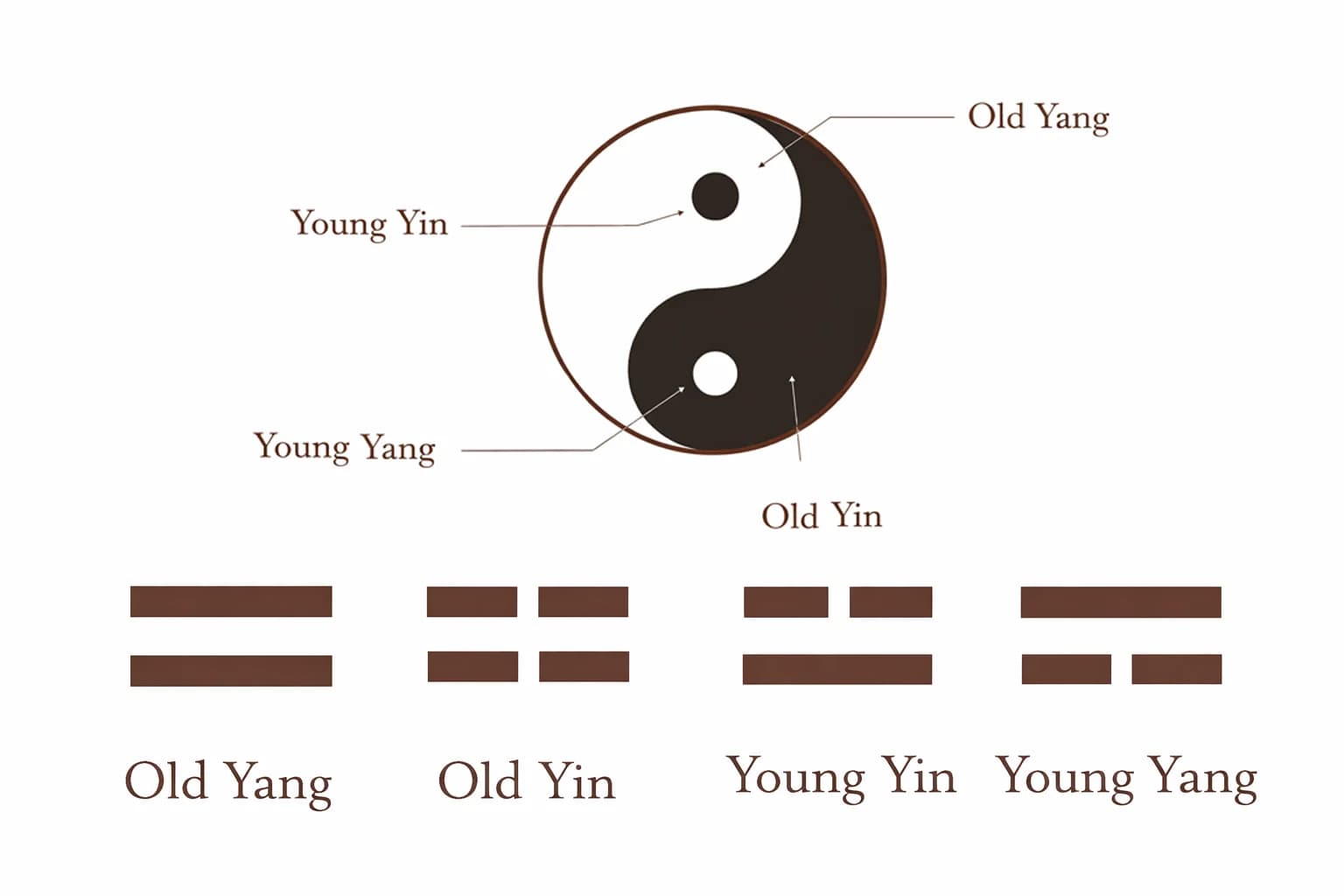
Once you have a solid line and a broken line, you already have polarity. The way the system works is we stack the lines on top of each other, starting at the bottom - the base. So if two lines are stacked, and the base line is broken and the top line is solid, that is yin (broken line) moving into yang (solid line).
If we open the system up and look at two lines and how they interact, there are four possible combinations: two solid lines, two broken lines, a broken line above a solid line, or a solid line above a broken line.
These four possibilities mirror, in symbolic form, what is being described in the image of the yin yang. The yin yang can be imagined as a black fish with a white eye and a white fish with a black eye. The large black portion may be understood as old yin, and the white eye within it as the seed of young yang. The large white portion may be understood as old yang, and the black eye within it as the seed of young yin. In this way, each force already contains the beginning of its opposite.
This helps illustrate one of the central ideas of the I Ching: nothing is static. When yin reaches its fullest expression, it is already beginning to turn toward yang. And when yang reaches its fullest expression, it is already beginning to turn toward yin.
This two-line system gives us more depth than a single line alone. But when we add a third line on top, something even more important happens: we create a natural tie-breaker. With three lines, there will always be either a majority of yin or a majority of yang, or else all three lines will be the same. That gives the figure a definite energetic leaning.
Three-line figures are called trigrams. And once the three lines are placed in lower, middle, and upper positions, they are not just counted - they begin to interact.
Traditional thought often relates these three positions to Earth, Humanity, and Heaven. The bottom line corresponds to Earth, the middle to Humanity, and the top to Heaven. So with three lines, the system suddenly has polarity, majority and minority, position, and relationship.
This is the point where the I Ching truly begins to come alive.
The Eight Trigrams, or Ba Gua
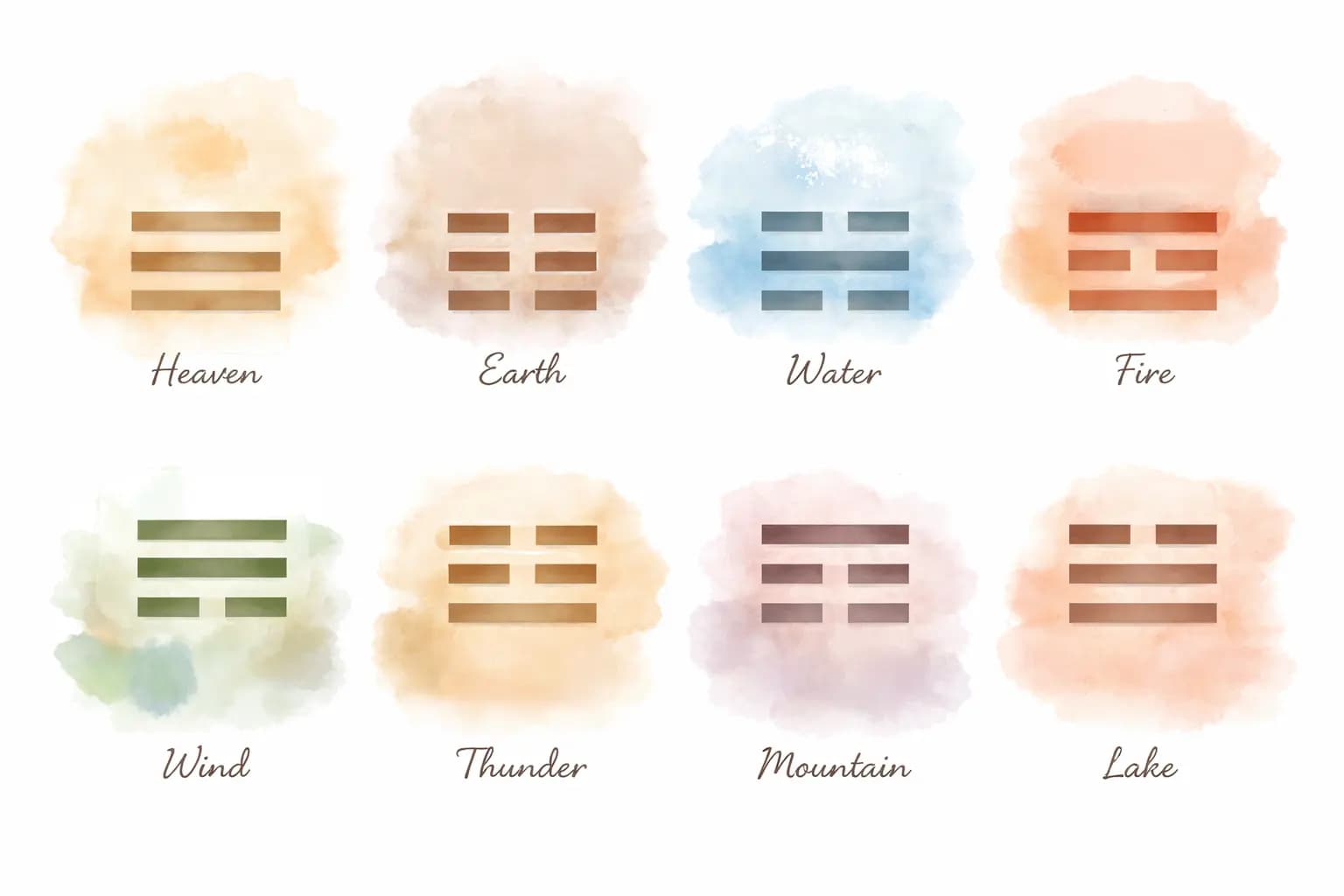
When you arrange broken and solid lines into every possible three-line combination, you get the Eight Trigrams, or Ba Gua. The source texts list them as Qian, Kun, Zhen, Xun, Kan, Li, Gen, and Dui. They are commonly understood as:
- Qian - Heaven or the Creative
- Kun - Earth or the Receptive
- Zhen - Thunder
- Xun - Wind
- Kan - Water
- Li - Fire
- Gen - Mountain
- Dui - Lake
These are not just natural images or elements. They are energetic patterns. Each one carries mood, movement, quality, and principle. Heaven creates. Earth receives. Thunder stirs. Wind penetrates. Water flows into depth. Fire illuminates. Mountain stills. Lake opens and gathers.
This is where the I Ching stops feeling abstract and starts feeling alive. If you are curious about experiencing this system firsthand, I Ching readings offer a way to engage with the hexagrams directly in relation to your own life questions.
From Trigrams to Hexagrams
Now that we have these eight elements, the I Ching puts them together to see how they interact with each other and themselves.
Once one trigram is placed on top of another, you get a hexagram. A hexagram has six lines in total, and because there are eight possible trigrams, their combinations create the 64 hexagrams of the I Ching.
A hexagram is not just six lines stacked together. It is the meeting of two fields of energy:
- The lower trigram can be understood as what is arising from within, from below, or from the inner side of a situation
- The upper trigram can be understood as what is unfolding outwardly, above, or ahead
So a hexagram becomes a picture of relationship - inner and outer, self and world, ground and direction, present condition and emerging movement.
This is why the I Ching does not feel random once you begin to understand it. Its symbols are built on pattern, relationship, and transformation.
The Deeper Beauty of the I Ching
The I Ching is profound because it builds an entire symbolic universe from almost nothing. A broken line. A solid line. From those two, all the trigrams arise. From the trigrams, all the hexagrams arise. And from the hexagrams, an entire philosophy of change unfolds.
That is the beauty of the Book of Changes. It begins with the simplest possible visual language, and from that simplicity, a whole world opens.
Frequently Asked Questions
Because the I Ching is built as a symbolic system before it becomes a written one. Its first language is visual. A broken line and a solid line express polarity in the simplest possible form, allowing the whole system to grow from direct pattern rather than abstract explanation.
Three lines create something crucial: a definite energetic leaning. With three lines, there will always be either a majority of yin or yang, giving the figure character, direction, and internal relationship. This is why the trigram is such a powerful symbolic building block.
A trigram is a three-line figure made from combinations of broken and solid lines. A hexagram is created when one trigram is placed on top of another, making a six-line figure. Trigrams show basic energetic patterns, while hexagrams show how two patterns meet and evolve.
You can begin by studying the 64 hexagrams, or you can experience the system directly through a guided I Ching reading. A reading brings the symbolic language into dialogue with a real question from your life.